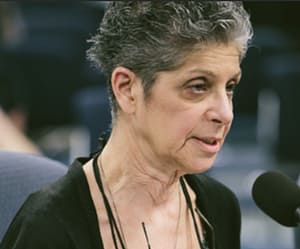
Stacey Gibson testifies before the New York State Assembly Health Committee in 2018.
Stacey Gibson of Garrison, in New York’s Hudson Valley, joined the end-of-life options movement in 2015 after her husband, Sid, died a horrible death after he stopped eating and drinking in the final stages of a debilitating progressive neurological disease.
Among the vanguard of New York’s volunteers for the entire decade-long legislative campaign, Stacey shared her highlights from this year’s successful session and tips for budding medical aid-in-dying activists.
Q: What was your top highlight of New York’s 2025 legislative session?
A: While the 2025 legislative season had many highlights, the major highlight for me was sitting in the gallery during the Assembly vote on the Medical Aid in Dying Act. I’ve been advocating for M.A.I.D. since the first lobby day 2015. Over the last ten years, there were times when it seemed we would never get the bill to the floor for a vote. And yet here I was sitting in our Capitol building, watching our democracy at work, on a piece of legislation that is so personal to me. I listened to heartfelt debate on both sides and when they started the vote, I could barely breathe. When the vote ended, and the votes tallied, and it passed, I was completely overwhelmed with emotion. At that moment, my only thought was of my late husband Sid, for whom I started this work, and that my promise to him to make things better for all New Yorkers may actually be fulfilled.
Q: What do you feel is the most effective way to talk to lawmakers about medical aid in dying?
A: I’m not sure there is one most effective way to talk to lawmakers about medical aid in dying. Lawmakers are a diverse group of individuals with varying perspectives. Like all of us, they come to this issue with different values and views that must be heard and understood. Over the years of advocating, I have found that sharing our personal stories as to why we feel medical aid in dying should be an available option across the state is extremely effective when combined with open and candid conversations that address lawmakers’ questions and concerns. This combination of making the bill ‘live’ through storytelling and honest eyeball-to-eyeball talk has been a winning strategy. And when I say ‘win’ I don’t mean they necessarily agree with the bill. But at least they come away with a better understanding of what we are advocating for and hopefully respect what we are about.
Q: Is there anything you wish you knew about the legislative process or legislative advocacy before you joined the campaign?
A: I’ll admit naivety in thinking this bill would be embraced by all and passed immediately. I must thank the various leaders of our campaign for educating us and filling in the knowledge gaps. It was a lot of continual work for them. The one thing I will always take away from my advocacy over the years is the deep friendships that have developed. You can’t work on an issue as personal as medical aid in dying, share your heartbreaking stories over and over again, and not fall in love with everyone dedicated to this mission. It is an experience I will take with me for the rest of my life.

Mail contributions directly to:
Compassion & Choices Gift Processing Center
PO Box 485
Etna, NH 03750
Compassion & Choices is a 501 C3 organization. Federal tax number: 84-1328829