

A dying Lombard mom, health and community advocates urged legislators to pass the End of Life Options for Terminally Ill Patients Act (SB9). The bill, which would allow mentally capable, terminally ill adults with six months or less to live the option to request a prescription for medication that they could decide to take to die peacefully., was presented Friday during an emotional hearing before the Illinois Senate Executive Committee.
The compassionate bill, sponsored by Sen. Linda Holmes (D-Aurora), Sen. Laura Fine (D-Glenview), and Sen. Karina Villa (D-West Chicago) was first introduced in 2024 and since has been gaining support among advocates and legislators. A companion bill, HB 1328, was introduced this session by House Majority Leader Robyn Gabel (D-Evanston), Rep. Kelly Cassidy (D-Chicago), Rep. Harry Benton (D-Plainfield), and Rep. Mary Beth Canty (D-Arlington Heights).
Passing the medical aid in dying bill would fulfill one of the last wishes of Deb Robertson, a 66-year-old Lombard mother and grandmother living with a rare, aggressive and terminal cancer known as neuroendocrine carcinoma, and a member of the Illinois End-of-Life Options Coalition who testified at the hearing on Friday.
Robertson is using her last weeks or months she has left to live to advocate for lawmakers to pass the bill that would allow terminally ill Illinoisians adults with six months or less to live the option to request and receive a prescription for medication that they could decide to take to die peacefully.
“I love my life, I don’t want to die.. I love my family but I am still going to die,” said Robertson. “When the time comes, I pray this committee and others will allow me this option..to die peacefully and on my own terms.”
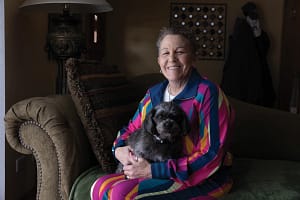
Deb Robertson and her dog Nellie
Sen. Holmes, who is living with multiple sclerosis, noted the bill’s passage is personal to her. She said both her parents suffered horribly before their deaths to cancer.
“Losing someone you love is tough,” she said “Watching someone you love suffer is worse.”
“The use of medical aid in dying is completely optional and strictly voluntary for physicians,” said Diana Barnard MD, a palliative care/primary care provider who prescribes the aid-in-dying medication to terminally ill patients in Vermont. “These laws are working well and working as intended. It offers immense comfort [to dying patients.]”
“The End of Life Options for Terminally Ill Patients Act is a compassionate and gentle end-of-life care option for people who are already dying,” said Callie Riley, Regional Advocacy Director, Compassion & Choices. “We urge legislators to pass the End-of-Life Options Act, and give Illinoisans access to a full range of end-of-life options.”
Suzy Flack, from Naperville, testified about the death of her only son, Andrew ‘Drew’ Flack, who died peacefully at 34 years-old from colorectal cancer after using the End of Life Option Act.
Andrew, a special education teacher, spent his last months of life advocating for medical aid in dying in his home state of Illinois by recording a video.
“When Andrew took his medication.. It was a wonderful day,” Flack said. “Andrew lay on his bed. We listened to his ‘going out’ tunes. Andrew took that spoon…took the medication… Within two minutes, Andrew was sound asleep, snoring. Two hours later, Andrew took his last breath. It was a peaceful and beautiful death. His last words were ‘I’m happy.’”
Legislators also heard written testimony from Nilsa Centeno, mother of the late medical aid in dying advocate Miguel Carrasquillo.
Centeno testified that Carrasquillo was a chef at Petterino’s in Chicago when he was diagnosed with an aggressive brain tumor that spread to his liver, stomach, testicles and other vital organs. Carrasquillo became a voice for Latinos by advocating for medical aid in dying by recording videos in English and Spanish. Carrasquillo suffered before his 2016 death without the end of life option he desperately fought for. He was only 35 years-old.
“Miguelito’s voice was frail…His words were mumbled…yet he reminded me to keep fighting for his legacy to authorize medical aid in dying,” Centeno stated in the written testimony translated from Spanish to English. “Although my son’s voice has gone silent, mine has not.”
Polling shows seventy one (71%) of Illinoisans who want the Illinois legislature to pass medical aid-in-dying legislation. This majority spans the demographic, political, racial, and religious spectrums, including 87% of Democratic voters, 86% of Latino voters, 73% of voters living with disabilities, 69% of Independent, African American/Black, White, and Catholic voters, 58% of non-Catholic Christians and 50% of Republican voters.
Eleven jurisdictions have authorized medical aid in dying, including 10 states, California, Colorado, Hawaii, Maine, Montana, New Mexico, New Jersey, Oregon, Vermont, and Washington, as well as Washington, D.C. Collectively, these 11 jurisdictions represent one out of five U.S. residents (22%) and have decades of combined experience successfully implementing this medical practice, starting with Oregon in 1997.
CONTACTS
Joanna Klonsky, c. 312-307-0840 [email protected]
Spanish-language media:
Patricia A. González-Portillo, 323-819-0310, [email protected]
The Illinois End-of-Life Options Coalition is a statewide partnership dedicated to raising both awareness and support across Illinois for medical aid in dying for terminally ill adults. The coalition’s goal is to authorize medical aid in dying and ensure that terminally ill people who want it can access it. The coalition’s partners include ACLU Illinois, Compassion & Choices Action Network Illinois, and Final Options Illinois. Learn more about their work at illinoisoptions.org

Mail contributions directly to:
Compassion & Choices Gift Processing Center
PO Box 485
Etna, NH 03750
Compassion & Choices is a 501 C3 organization. Federal tax number: 84-1328829