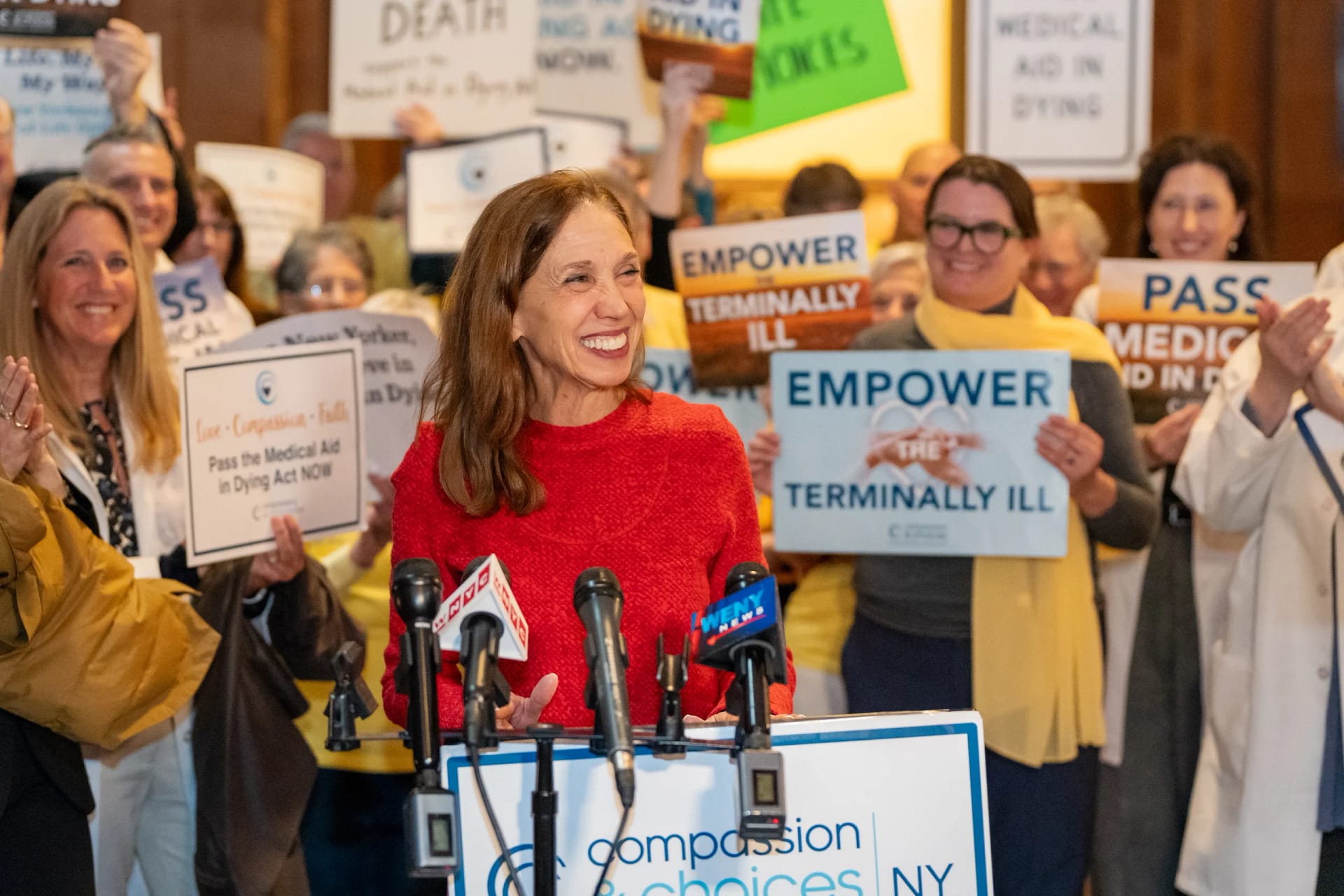
What to Know about New York’s Medical Aid in Dying Act

For New Yorkers facing their final months, weeks, or days with a terminal illness, New York’s Medical Aid in Dying will provide comfort and compassion. 

First introduced in 2016 and passed by the state legislature in 2025, Governor Kathy Hochul signed the bill with added amendments on February 6, 2026. 

New Yorkers overwhelmingly support medical aid in dying by a 72-23% margin. Read more about public support here.


Medical Aid in Dying in New York: At a Glance

New York Medical Aid in Dying Act

A136 (Paulin) / S138 (Hoylman-Sigal)

Signed into law February 6, 2026

Takes effect August 5, 2026

The Legislation Allows:

A terminally ill, mentally capable adult with a prognosis of 6 months or less to live to have the option to request, obtain and decide to ingest medication to die peacefully in their sleep if suffering is unbearable.

The bill is modeled after the Oregon Death with Dignity Act, which has been in effect for more than 20 years without a single instance of abuse or coercion.

Eligibility Criteria

Just like the Oregon Death with Dignity Act, to be eligible, a person must:

  • Be an adult, aged 18 or older
  • Be a resident of New York State
  • Have a medically confirmed terminal illness that is incurable and irreversible and will likely cause death within 6 months
  • Be mentally capable of making an informed health care decision

Individuals are not eligible for medical aid in dying because of age or disability.

Additional Requirements

  • Two physicians must confirm that the person is terminally ill with a prognosis of 6 months or less to live, is making an informed health care decision and is not being coerced.
  • The initial evaluation of the patient by the attending physician must be conducted in person, unless the attending physician determines that an in-person visit would result in extraordinary hardship to the patient.
  • The attending physician must inform the requesting individual about all of their end-of-life care options, including palliative care and hospice.
  • A mandatory mental health evaluation must be conducted by a psychologist, neurologist, or psychiatrist to determine that the person has the capacity to make an informed health care decision. The mental health provider must confirm in writing the dying person’s capacity before a prescription can be written.
  • The individual must make an oral and a written request for aid-in-dying medication, witnessed by two people — neither of whom can be a relative, someone who stands to benefit from the person’s estate, or anyone who may benefit financially from the person’s death.
  • The oral request must be recorded by video or audio and permanently stored in the patient’s medical record.
  • There is a mandatory waiting period of 5 days between when a prescription is written and when it may be filled, unless the attending physician determines that the patient is not expected to survive that period.
  • The terminally ill person can withdraw their request for aid-in-dying medication, not take the medication once they have it or otherwise change their mind at any point in time.
  • The individual must be able to self-ingest the medication.
  • No physician, health provider or pharmacist is required to participate in medical aid in dying.
  • Religiously-oriented home hospice providers may opt out of offering medical aid in dying; however, a patient receiving hospice care in their own home may not be prevented from accessing medical aid in dying.
  • Those who do and comply with all aspects of the law receive civil and criminal immunity.
  • A violation of this law constitutes professional misconduct under the New York Education Law.
  • Anyone attempting to coerce a patient will face criminal prosecution.
  • Unused medication must be disposed of as required by state and federal laws.
  • Health insurance benefits are unaffected by the availability of medical aid in dying and life insurance payments cannot be denied to the families of people who use the law.
  • The New York Health Commissioner is required to issue a publicly available annual report about the usage of the law. Patient and physician identifying information is kept confidential.
  • The law takes effect six months after signing, allowing the Department of Health to promulgate necessary regulations and enabling health care facilities to prepare and train staff for compliance.

Six months after signing, which is expected to take place in early 2026, to allow time for regulations and provider preparation.

No. Unfortunately not. While we strongly encouraged the Governor to allow for a waiver in cases like this, the administration declined to act on this request.

With the amendments to the bill passed by the New York State Legislature requested by Governor Kathy Hochul, once signed, New York’s Medical Aid in Dying law will not go into effect until sometime in July 2026 (the exact date will depend on when the Governor signs the bill, and the effective date will be 6 months from that day). If you or someone you know is terminally ill and interested in making a request for medical aid in dying under the new law, there are several things you can do to lay the groundwork for your request. 

  1. If you have been diagnosed with a terminal illness and are considering medical aid in dying for yourself, familiarize yourself with the eligibility requirements. Medical aid in dying has strict eligibility criteria (see answer to the next question about eligibility below); a person is not eligible based on age or disability alone. You can read about what medical aid in dying is here, and you can read the bill language here. Once the final amendments are passed by the legislature, come back and visit this page again for an update that will include a summary of the bill and a checklist for eligibility. 
  2. Have a conversation with your doctor as soon as possible to determine whether that doctor is willing to grant your request for medical aid in dying. If your doctor needs more information, you can share this resource page which provides information on resources and programs that support clinicians, available at no cost.
  3. Begin to identify a psychiatrist, psychologist, or neurologist who will be willing to complete a mental health evaluation, which is part of the determination of eligibility for medical aid in dying in New York. You can do this by asking your existing healthcare providers for a referral, or by calling your insurance company to ask for a referral. 

We want to hear from you! If you experience any problems or barriers to care, please let us know by sending us an email to [email protected]. We will be closely monitoring how this law is working for terminally ill New Yorkers and their healthcare providers. 

Public education, provider training, and implementation planning has already begun.

The New York State Department of Health will be charged, under New York’s Medical Aid in Dying Act once it is signed, to develop regulations and guidance for providers. Please watch this space for those resources, when they become available.

The New York State Department of Health will be charged, under New York’s Medical Aid in Dying Act once it is signed, to develop regulations and guidance that will help determine how a patient can access the new law. Please watch this space for those resources when they become available.

Gratitude to Our Advocates and Partners

This progress reflects years of work by advocates, storytellers, family members, clinicians, faith leaders, legal experts, alliance partners, and individual and organizational supporters across New York. Many shared deeply personal experiences about terminal illness, loss, and end-of-life care, helping build understanding and momentum statewide. Some advocated while living with terminal illness themselves; others continued the work after losing loved ones.

We are deeply grateful to Assemblymember Amy Paulin and Senator Brad Hoylman-Sigal, the bill’s sponsors, for their steadfast leadership, and to the many lawmakers, volunteers, coalition partners, and Compassion & Choices staff who began this work and carried our campaign forward year after year.

Send a note of gratitude of your own to your elected officials, Assemblymember Paulin, Senator Hoylman-Sigal, and Governor Kathy Hochul. 

What This Means for Patients and Families

Medical aid in dying will not be available immediately upon signing. The agreement includes a six-month implementation period, allowing the Department of Health to finalize regulations and healthcare providers to prepare.

During this time, Compassion & Choices will focus on public education and provider engagement so patients, families, and clinicians understand what the law does—and does not do—and how eligible New Yorkers can access it once it takes effect.

Agreed-Upon Amendments

The Legislature is expected to pass amendments to the Medical Aid in Dying Act requested by Governor Hochul, including:

  • A mandatory waiting period of 5 days between when a prescription is written and filled, unless the patient’s attending physician believes the patient will die within that period;
  • An oral request by the patient for medical aid in dying must be recorded by video or audio and permanently stored in the patient’s medical record;  
  • A mandatory mental health evaluation of the patient seeking medical aid in dying by a psychologist, neurologist, or psychiatrist; 
  • Strengthening a prohibition against anyone who may benefit financially from the death of a patient from being eligible to serve as a witness to the oral request or an interpreter for the patient;  
  • Limiting the availability of medical aid in dying to New York residents;
  • Requiring that the initial evaluation of a patient by a physician be in person, unless attending physician believes an in-person visit would result in extraordinary hardship; 
  • Allowing religiously-oriented home hospice providers to opt out of offering medical aid in dying, while ensuring a patient receiving hospice care within their own home is not restricted from accessing medical aid in dying; 
  • Ensuring that a violation of the law is defined as professional misconduct under the Education Law; and 
  • Extending the effective date of the bill to six months after signing to allow the Department of Health to put into place regulations required to implement the law while also ensuring that health care facilities can properly prepare and train staff for compliance.

We will continue to review the final amendment language and share updates as details are finalized.

The Work Ahead

This milestone is significant, but implementation matters. Compassion & Choices remains committed to ensuring this law is understood, implemented thoughtfully, and accessible statewide—not limited by geography, resources, or familiarity with the healthcare system.

We will continue working with the Governor’s office, the Legislature, healthcare providers, and communities across New York—and we stand ready to defend this law if challenged.

What Patients and Families Should Know

The Medical Aid in Dying Act will give eligible, terminally ill New Yorkers the option to request medication from a doctor that they may choose to take to bring about a peaceful death.

If the Legislature passes the agreed-upon amendments and the Governor signs the bill, the law will take effect six months later. During that time, the New York State Department of Health will develop regulations, and healthcare providers will prepare to offer care in compliance with the law.

Medical aid in dying is voluntary for everyone involved. No patient is required to pursue it. No healthcare provider, pharmacist, or hospice is required to participate.

Compassion & Choices will provide clear, accurate information to help patients and families understand:

  • Who may be eligible

  • How the process works

  • What safeguards are in place

  • How to find support and resources when the law takes effect

So please keep your eyes on this page for updates!

Our goal is to ensure that New Yorkers who qualify for this option can access it without confusion, fear, or unnecessary barriers.

General Mailing Address:
Compassion & Choices
8156 S Wadsworth Blvd #E-162
Littleton, CO 80128

Mail contributions directly to:
Compassion & Choices Gift Processing Center
PO Box 485
Etna, NH 03750

Compassion & Choices is a 501 C3 organization. Federal tax number: 84-1328829

candid seal platinum 2025
great nonprofits 2024 top rated badge
Question 1 of 14

Your information entered here will be included on the final copy of your Dementia Advance Directive (addendum).

Name
Birth Date
Paso 1 de 14

Yo estoy completando este documento porque quiero que mi(s) persona designada (s) en la toma de decisiones, médicos y equipo de atención médica, familia, cuidadores y seres queridos conozcan mis deseos respecto al tipo de cuidados que deseo si vivo con demencia.

Nombre
Fecha de nacimiento
Question 1 of 14

Your information entered here will be included on the final copy of your Dementia Advance Directive (addendum).

Name
Birth Date