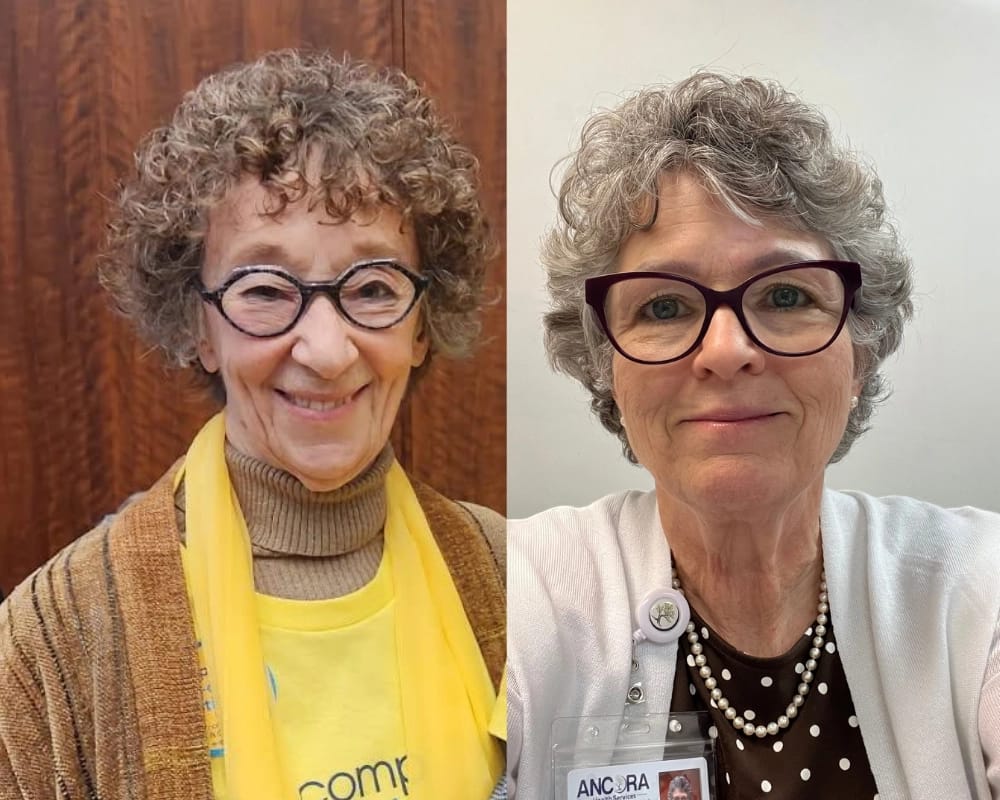
When Karen Midlo goes to senior fairs as a Compassion & Choices volunteer, she brings a box with a ribbon around it. Next to the box, she places a sign that reads, “What is the greatest gift you can give your family?”
“No one ever says, ‘Having my advance directives done,’” Karen laughs.
But for Karen, a community educator for Ancora Health Services in Idaho, an end-of-life doula, and a Compassion & Choices volunteer since 2024, there is nothing more gratifying than helping people plan for the end. She knows what a gift it is to loved ones to make your wishes known, and she wants everyone else to know that, too.
It’s the same for longtime Compassion & Choices volunteer Fay Clayton. For a decade, Fay has advocated for the full spectrum of end-of-life care in Illinois, including medical aid in dying. Her volunteer leadership since 2016 was vital to medical aid in dying being authorized in Illinois this year — but that doesn’t mean the work is finished for Fay.
Fay’s passion for patient rights at the end of life now propels her advocacy for meaningful access to the end-of-life care people want.
I’m sharing about Fay and Karen because the work they have been doing is essential to the future Compassion & Choices is building toward.
We’ve heard you on what you want that future to look like: You want medical aid in dying accessible wherever you live. You want better and more meaningful options if dementia becomes a part of your life. And you want healthcare at the end of life to reflect your values and informed decisions.
This means changing what people expect from end-of-life care and changing the healthcare systems that provide it. This change starts in communities, when people talk to their friends and neighbors, engage healthcare organizations, and create new expectations for what quality end-of-life care should look like. Combine that with resources, expertise, technology, training, and tools, and you have the conditions for lasting change in end-of-life care.
To do that, we need a bigger, more locally-led volunteer movement. We need more people like Fay and Karen.
What does that look like? According to them, it’s “a joy.”
Fay Clayton’s first job as a volunteer with Compassion & Choices was cold calling Colorado residents about an attempt by Congressional legislators to invalidate Washington, D.C.’s medical aid-in-dying law, urging Coloradans to put pressure on their senator to not take this option away from D.C. residents.
“Making those cold calls was satisfying,” Fay remembers. “Nearly every person I called was happy I was doing it and supportive of our effort. One woman I called said, ‘I can’t make any notes right now because I’m walking my baby in the park, but I promised my mother I would continue this work.’ Her mother had died recently and medical aid in dying was important to her. She told me to call her back and leave a message with instructions and that she would do them. So not only was this work not a chore; it was a joy.”
Next, Fay and her friend Missy Fleming set up a volunteer action team in Evanston to get a medical aid-in-dying bill passed in her home state, and they began having monthly meetings.
“I made some very, very good friends this way. People just step up and do their part, speaking at places of worship, libraries, farmers markets. We table, we speak. Because it’s important to us.”
Another part of Fay’s volunteer work was reaching out to hospices in the area to learn about their policies on advance directives, including if they would honor a patient’s decision to use VSED. They shared the information they gleaned with local action teams.
Then, in December 2025, Governor Pritzker signed the Illinois End-of-Life Options Act, also known as Deb’s Law. Fay was overjoyed, proud, and relieved that she would have this option in her home state.
But Fay wasn’t about to sit back. As soon as the law passed, she and her volunteer team began reaching back out to the hospices they had spoken with before to share information, offer presentations, and evaluate their policies on medical aid in dying. She’s spoken about end-of-life care at Continuing Care Retirement Communities (CCRCs), in skilled nursing facilities, and with her own doctors.
“I talk to everybody about this,” Fay says. “It’s important that we, as citizens, reach out to our healthcare providers and our neighbors and make sure they know about this important legal right. So it’s not only an important time to get the word out, it’s an exciting time.”
Karen Midlo has her “dream job”: teaching and inspiring people to talk about end of life. In her work as a community educator for a local hospice in her home state of Idaho, and as an end-of-life doula with Doulagivers, she’s doing this day-in and day-out, from people’s living rooms to hospitals.
But even with her dream job, Karen felt she could do more, spend more time helping people have a voice in how they live and how they die. So in 2024, she started volunteering for Compassion & Choices.
“Every time I meet with a doctor or other clinician, I give them one of the End-of-Life Decisions Guides,” Karen says. “Every single group I teach, they get a copy. I had a meeting with the director of AARP for Idaho last week, and I gave her a copy.”
Karen loves sharing Compassion & Choices resources because they are easy to follow and consistently well-received by the folks she shares them with.
“I’ve looked at other planning tools, but none of them go as deep as the [End-of-Life Decisions] Guide. It looks at so many different facets of advance care planning, including your values around dementia.”
Karen frequently refers to other resources on the Compassion & Choices website, from information about hospice to VSED. She just recently discovered our Diagnosis Decoder and was thrilled.
And Karen’s work doesn’t stop at handing out resources.
“It’s one thing to get the guide in people’s hands; it’s another to get it completed,” she says.
Karen has her own tactics for helping people document their wishes. One that she recommends is having a friend interview you and fill out the pages of the guide as you answer their questions. She recently taught an advance care planning class at a senior living community. Naming the class “Getting your ducks in a row” proved to be much more enticing to residents than “Filling out your advance directive.” For Karen, it’s about making the process of end-of-life care planning interactive, fun, and lighthearted.
“The thing I tell families is, ‘Hope is not a plan,’” Karen says. “The most gratifying thing to me is to have someone who did not have their advance directive done get it completed, because now they have a say in their care.
“For us as volunteers, it’s all about being excited about this, approaching it with the view of having the best life we can all the way to the end.”
The excitement and joy Fay and Karen get out of their volunteer work with Compassion & Choices is not only about their own passion for this work. It also speaks to the moment we’re in, on the precipice of a movement for patient-directed end-of-life care.
Whether you have been with Compassion & Choices for years or are just finding us, I hope you will take a look at our new volunteer page and tell us how you would like to be involved.
If you stepped back after a campaign ended or a law passed, we would love to welcome you back. If you are already active, we want to help you grow your leadership. And if you have never volunteered before, this is a great time to start.
You will not be doing it alone. You will be part of a community of people committed to this work, with the support of Compassion & Choices, making change where they live and across the country.
Volunteer and be a part of what comes next in the end-of-life care movement.
Mail contributions directly to:
Compassion & Choices Gift Processing Center
PO Box 485
Etna, NH 03750
Compassion & Choices is a 501 C3 organization. Federal tax number: 84-1328829