
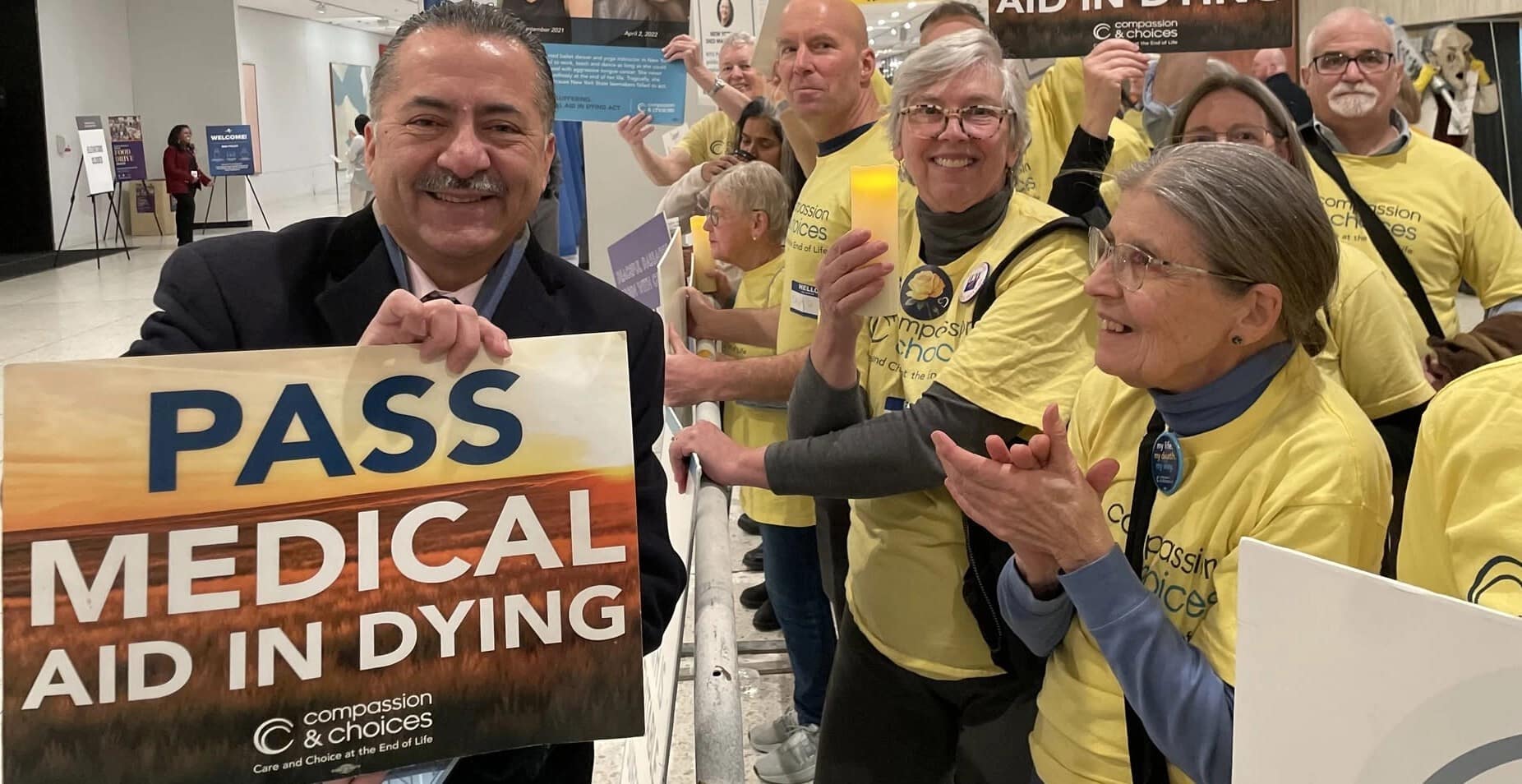
The movement to make medical aid in dying part of the gold standard of fully-informed, patient-directed end-of-life care is growing stronger every year, and 2026 has been no exception.
This has been a legislative season of expanding reach and deepening roots. Medical aid-in-dying bills were active in 15 states, from Georgia to Wisconsin. Some advanced further than ever before. Some fell agonizingly short.
All of these campaigns have laid groundwork for a movement that is unmistakably still gaining momentum. With so many competing priorities among lawmakers, the volume of bills introduced this year is a testament to the power of our movement.
Here’s a state-by-state look at where things stand on our most active campaigns:
Bills: H.2505 / S.1486 (End of Life Options Act)
Status: Active — moving in both chambers, regular session runs through July 31, 2026
Massachusetts is the clearest near-term opportunity for new authorization. The End of Life Options Act has majority support on both floors of the legislature, a supportive governor, and has passed favorably out of multiple committees.
The bill’s path through the current two-year session has been one of consistent forward motion. A public hearing took place in April 2025. By late June 2025, H.2505 cleared the Joint Committee on Public Health and moved to Health Care Financing. In October, the Senate bill joined it there. By mid-November, S.1486 had advanced to Senate Ways & Means — a meaningful signal of momentum in the upper chamber. Both chambers must advance their respective bills to the floor by July 31.
Bills: HB 886 / SB 359
Status: 2026 session ended; bills did not pass
Virginia’s 2026 session produced one of the most painful moments of this year’s campaigns. SB 359 failed by a single vote in the Senate Committee on Education and Health on February 5, 2026.
The House bill remained technically alive following the committee vote but did not advance before session ended. Virginia demonstrates both how close this issue is to breaking through in new states — and how much each individual vote matters.
Bills: HF 2998 / SF 3215
Status: 2026 session ended; no movement
Minnesota made historic committee progress in 2024. While the 2026 session didn’t yield a vote, the landscape is shifting in our favor. Both bills were reintroduced with sponsors and carried over from 2025 into the 2026 session, but budget priorities and procedural dynamics again crowded out the calendar before session ended in May.
Looking ahead, there is meaningful cause for optimism. A key opponent was rotated off the Senate Health & Human Services Committee and replaced by a lawmaker who is considered significantly more favorable on issues of bodily autonomy and civil liberties. If he remains on the committee in the next session, we anticipate a real opportunity in the Senate.
Bill: HB 1876
Status: 2026 session ended; bill did not progress
HB 1876 was an improvement bill championed by Rep. Skyler Rude (R-Walla Walla) and Rep. Strom Peterson (D-Snohomish), whose mother used New Mexico’s law. The bill, which would improve access by allowing the attending medical provider to waive the 7-day waiting period under certain circumstances, had a public hearing in early 2025 but ultimately stalled before session ended in March.
Bills: A3705 / S710
Status: Active two-year session 2026 – 2027
New Jersey’s existing law is also the focus of improvement efforts this session. The legislation, introduced January 13, 2026, would waive the 15-day waiting period between oral requests under certain circumstances and reduce the waiting period for the prescription to 48 hours. The bill has not yet received a committee hearing or vote in either chamber. It remains a live bill for the 2026–2027 session, but movement will depend on whether legislative leadership schedules it for committee consideration.
Massachusetts is the most immediate opportunity for a new law, with the session running through July 31. Michigan, New Jersey, Ohio, and Pennsylvania all have active sessions continuing through the final months of 2026.
The breadth of bill introductions this year reflects a movement that is not concentrated in a few regions. The conversation is spreading, and the infrastructure to sustain it is deepening with each session.
We’re also still awaiting the culmination of the bills successfully passed last year, with medical aid in dying set to become available to qualified residents of New York on August 5 and Illinois on September 12.
We will continue to update you throughout the rest of the year and into next year’s legislative season. To get involved or learn how to help expand and protect end-of-life care options in your state, please sign up to volunteer.
Mail contributions directly to:
Compassion & Choices Gift Processing Center
PO Box 485
Etna, NH 03750
Compassion & Choices is a 501 C3 organization. Federal tax number: 84-1328829