

Despite local and global uncertainty, 2025 has been a watershed year for Compassion & Choices and the end-of-life options movement. For the first time ever, three state legislatures passed legislation authorizing medical aid in dying in one year.
This was a year of tremendous progress, marked by long-fought authorization victories and steady defense of existing medical aid-in-dying laws across all regions, from New York to California.
More than a decade of organized campaign leadership and tenacious grassroots campaigning culminated this April with passage of the Delaware Ron Silvero/Heather Block End-of-Life Options Act. Gov. Matt Meyer signed the bill May 20, and the option will become accessible on January 1.
The law is named in honor of Dover resident Ron Silverio and Lewes resident Heather Block, two dedicated DE-based advocates who died in 2018 without access to the option they fought for. Silverio’s wife Susan Lahaie, a retired nurse practitioner, remained a staunch advocate in the years following his death.
“Ron would have said that terminally ill people of Delaware can now focus on living without having to worry so much about how they were going to die,” Lahaie said at the bill-signing ceremony.

Delaware Gov. Matt Meyer, seated, signs the Ron Silvero/Heather Block End-of-Life Options Act on May 20, 2025. Foreground far right, terminally ill Wilmington resident Judy Govatos congratulates him.
The work of another longtime advocate for patient-directed end-of-life care, Wilmington resident Judy Govatos, illustrates the need for all lawmakers to prioritize and expedite their consideration of medical aid-in-dying policy.
Following a 2014 diagnosis of stage 4 lymphoma, Govatos spent the last decade of her life championing medical aid in dying. In addition to legislative advocacy that included meeting with and testifying before lawmakers over several years, she was also a plaintiff in Compassion Legal’s lawsuit challenging the residency requirement in New Jersey’s medical aid-in-dying law. Judy died peacefully on November 14, 2025, having realized her goal of making medical aid in dying an option for terminally ill Delawarens.
About 300 miles north of Delaware’s Dover capital, after more than a decade of advocacy in Albany the New York State Legislature passed the Medical Aid in Dying Act — in the Assembly in April and the Senate in June.
First introduced in 2016, the bill passed with the support of a massive coalition of lawmakers and civic organizations representing the Empire State’s broad diversity. Supportive organizations included the Medical Society of the State of New York (MSSNY), New York State Academy of Family Physicians, the League of Women Voters of New York State, Planned Parenthood Empire State Acts and dozens more.
“It’s been a long road but thanks to the dedicated activists from groups like Compassion & Choices we have built the broadest coalition ever assembled of doctors, nurses, patients and legal advocates from across New York to support this bill,” said Senator Brad Hoylman-Sigal, senate sponsor of the bill, following its June 9 Senate passage.
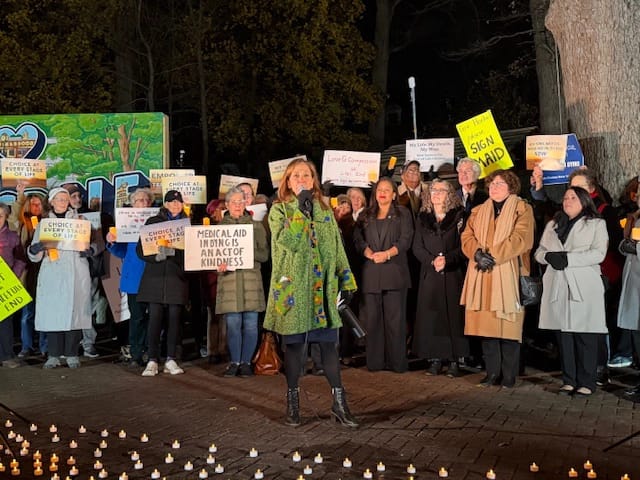
New York Assemblywoman Amy Paulin (center) joined faith leaders, state and local officials and hundreds of advocates at Chase Park in Scarsdale on Nov. 14 in support of the Medical Aid in Dying Act.
The coalition remains focused on Governor Kathy Hochul, who has until Dec. 31 to sign the bill into law. We will continue to share voices of support with Gov. Hochul for as long as the bill remains unsigned. Most recently, on Nov. 14 advocates gathered at Chase Park in Scarsdale (around 12 miles from NYC’s northernmost neighborhood in The Bronx) to place 2,500 candles symbolizing the number of New Yorkers who die of cancer each month. Cancer is the leading terminal illness suffered by people who choose medical aid in dying in authorized states.
“(Medical aid in dying) is not about giving up,” Paulin told gathered advocates, “it’s about giving terminally ill patients peace of mind and control in their final days.”
New Yorkers can write a message of support to Gov. Hochul using the advocacy form linked here.
As residents of The Big Apple await news of a governor’s signature, so do those in The Windy City.
In the early morning hours of the final day of Illinois’ unique fall “veto session” — a six-day period where lawmakers can both override or accept a governor’s veto and also to pass legislation that was not completed during the regular spring session — on October 31 the Illinois Senate approved the End-of-Life Options Act, also known as Deb’s Law. The House had passed the bill in May.
The bill was recently retitled to honor the advocacy of 66-year-old terminally ill Lombard (in Chicago’s western suburbs) resident Deb Robertson. A former social worker, Robertson retired from her decades-long job advocating on behalf of homeless youth following a 2021 diagnosis of aggressive high-grade neuroendocrine carcinoma.

Deb Robertson at her home in Lombard, Illinois.
“We don’t have any control over whether we get a terminal illness, but to have some control over how we leave this earth with a terminal illness is something that everyone deserves,” Robertson told Compassion & Choices in 2022. “Because this cancer has progressed so quickly, I want to do as much as I can for this cause while I’m still feeling decent,” she continued.
Amid cancer treatments, Robertson testified before lawmakers in February. “I love my life, I don’t want to die. I love my family but I am still going to die,” she said. “When the time comes, I pray (lawmakers) will allow me this option… to die peacefully and on my own terms.”
The bill is now with Governor J.B. Pritzker. In 2018, Pritzker replied affirmatively to a candidate questionnaire referencing medical aid in dying, saying, “I am in favor of putting this very personal decision in the hands of patients to make in consultation with their doctors.” While we are hopeful he will sign the bill, we will continue to share the stories of supportive Illinoisans while it remains on his desk.
In addition to authorization bills, this year also saw California’s governor sign legislation removing the sunset provision from the existing law, and local advocates in Maine succeed in improving their law by reducing the waiting period.
We also successfully defended medical aid in dying again in Montana — a critical but sometimes under-the-radar campaign since MT lawmakers only meet every other year. Also unique to this year’s session in Montana, Rep. Julie Darling introduced the first bill to proactively codify medical aid in dying into state law since 2011. While that bill did not advance out of committee, its introduction reflects the growing bipartisan interest in protecting end-of-life options across the country.
Bills to authorize medical aid in dying or improve existing laws were introduced in 23 states in 2025. In 2026, Compassion & Choices and Compassion & Choices Action Network will lead campaigns in Connecticut, Massachusetts, Minnesota, Maryland, Virginia and Florida. We are committed to supporting volunteer-led campaigns nationwide, with varying degrees of assistance tailored to each campaign’s needs.
We will also continue to challenge residency requirements — whether supporting legal advocacy in states like New Jersey and Colorado where cases are ongoing, or through legislation.

Mail contributions directly to:
Compassion & Choices Gift Processing Center
PO Box 485
Etna, NH 03750
Compassion & Choices is a 501 C3 organization. Federal tax number: 84-1328829