
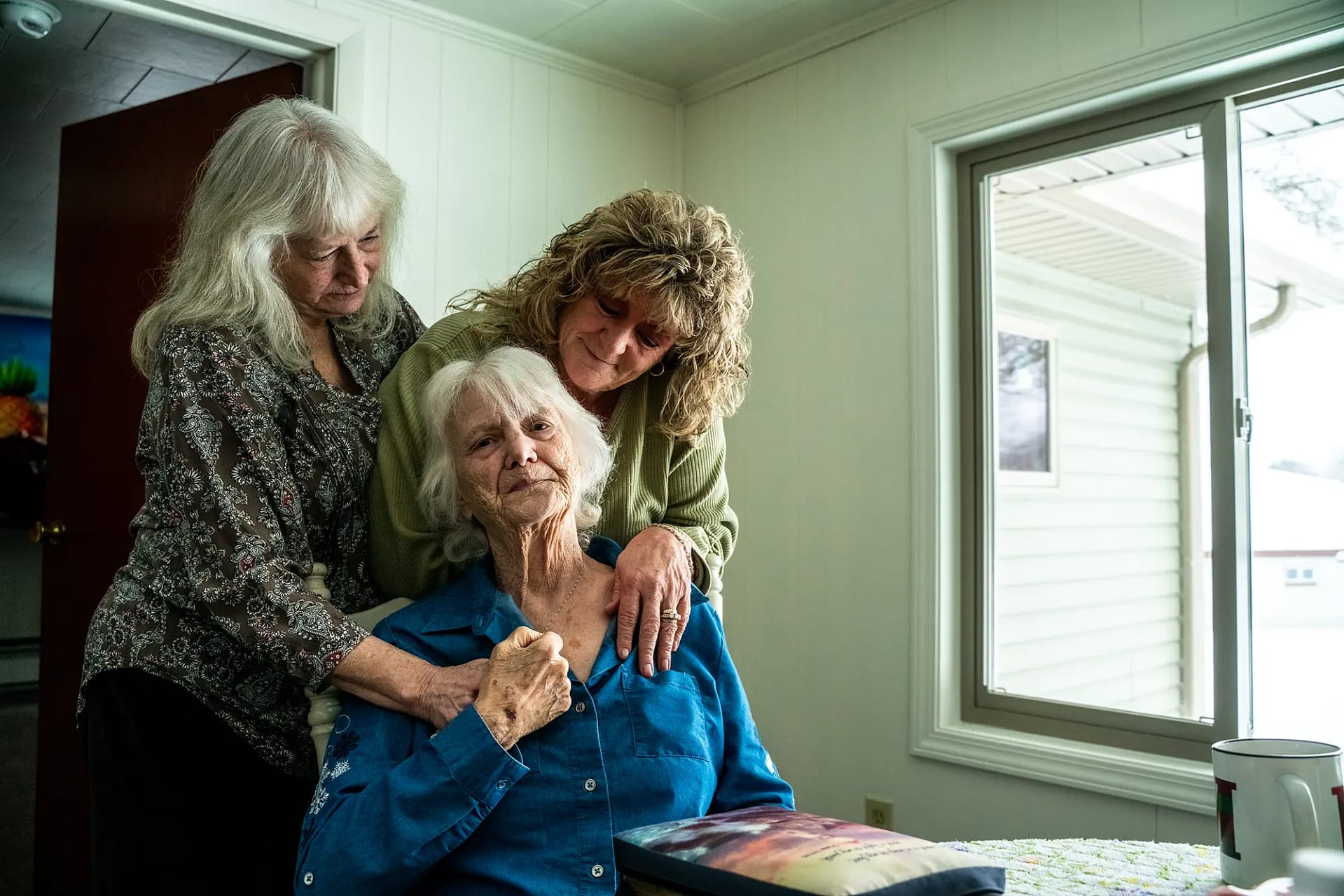
Editor’s note June 2025: Marie Cooper died at home on June 18, 2025, surrounded by her family of strong women.
Marie Cooper wants a natural death — no medical interventions to stop the dying process once it begins. She has never shied away from discussing this with her daughters, Sherry and Linda.
“Mom believes when it’s her time to go, there should be no interference by man,” Sherry said. “That’s between her and God. And she is adamant about that.”
In the fall of 2023, 80-year-old Marie was in good health, active and independent. When she started experiencing stomach issues later in the year, however, her primary care physician recommended an endoscopy to look for cancer cells.
In addition to her beliefs about natural death, Marie did not want to experience the physical repercussions of traumatic resuscitation or intubation. Her advance care documents reflected her wishes, including do-not-resuscitate (DNR) and do-not-intubate (DNI) orders. In January 2024, Marie updated her advance directive and filed it with the West Virginia e-Directive Registry and the national registry.
Marie’s endoscopy was scheduled for February 27, 2024.
As her mother’s medical power of attorney, Sherry accompanied Marie to each of her pre-op appointments, confirming that hospital staff had Marie’s advance directive and DNR/DNI on file. The morning of the scheduled endoscopy, Sherry did the same with the intake staff at J.W. Ruby Hospital in Morgantown. The plan was for Sherry and Linda to wait while Marie had the scope done, go to lunch and do a little shopping before heading home that afternoon.
The procedure went smoothly. But when Sherry went to the recovery room to see Marie, she noticed her mother was having difficulty breathing, and a glance at the monitor revealed her rapidly changing blood pressure and heart rate. Sherry left Marie to get help, expecting the familiar non-invasive nebulizer and BiPap treatments she had used in the past.
A nurse announced they were admitting Marie and sent Sherry to the waiting room.
“I remember my girls coming in and kissing me and telling me goodbye,” Marie told Compassion & Choices. “And I told them I love them. But I was ready. I couldn't lie to them, I was ready. And they knew that.”
Nearly seven hours passed.
When Sherry was finally allowed into the ICU to see her mother, she found Marie intubated, sedated, covered in tubes and tied to the bed. None of the doctors could answer her questions about why Marie had been intubated despite her DNI.
Over the next 10 days, Marie developed pneumonia, then septic shock, before she eventually recovered enough to be discharged.
Marie’s life since returning home is dramatically different. Since the intubation, she suffers from burning pain in her throat and mouth. She experiences severe tremors that require medication. She has frequent nightmares about the hospital stay, and her daughter and granddaughters often wake to her screaming in the night. She feels her religious beliefs have been violated and says she now fears the hospital and doctors, no longer trusting that they have her best interests in mind.
“Before, I could cook anything, bake anything. I could clean my house. Go on camping trips, dance at my granddaughter’s wedding,” Marie said. “I can’t do that now, and that really bothers me.”
What happened to Marie is all too common, an example of the repercussions when patients are denied medical autonomy. When a New York Times article detailing Marie’s experience was published in August 2024, it garnered nearly 2,000 comments within days, nearly all of them expressing sympathy with Marie and her family and describing similar experiences of friends and family members attempting to have their end-of-life wishes respected by hospitals and care facilities.
Veronica Darling, director of litigation at the End of Life Justice Center at Compassion & Choices, emphasized that hospitals need to respect advance directives in all medical interactions, not simply life-threatening ones.
“Marie and her family did the difficult and important work of sitting down to understand what Marie wanted and documented her wishes, only to have that disregarded by medical staff,” Darling said. “I recommend asking your healthcare providers what additional information the facility needs to be sure your advance directive is honored, regardless of the situation.”
Marie and her daughters are working with Compassion Legal to explore her options to ensure this doesn’t happen to another family going forward.
“The experience of working with Compassion Legal has been a relief to us — a relief in the sense that someone hears us,” Sherry says. “Compassion & Choices, I hope, can make a difference. I hope they can bring enough public awareness that this stops.”
Despite all that she’s been through, Marie is animated by the same hope: that her story can effect change.
“I wouldn’t be suffering here like I am now if they’d have just left me alone. That’s all I asked,” she said. “And I’m going to fight as hard as I can fight. I really am.”

Note: We are not a general legal services provider. We focus on legal issues specifically related to end-of-life care and patient autonomy.

Mail contributions directly to:
Compassion & Choices Gift Processing Center
PO Box 485
Etna, NH 03750
Compassion & Choices is a 501 C3 organization. Federal tax number: 84-1328829